Artifacts
Deliverables your agents produce — hosted Claude artifact pages, Antigravity task/plan/walkthrough docs, screenshots, recordings — collected per session and per project.
Artifacts are the things your agents produce beyond code: hosted result pages, task lists and walkthroughs, screenshots, browser recordings. TokenTelemetry finds them in each agent's own storage and shows them in two places:
- Per project — the Artifacts tab in a project workspace lists the deliverable artifacts from every session in that project.
- Per session — the Artifacts tab in a session trace lists everything that session produced, including raw files.
Everything is read from local agent storage. Nothing is uploaded or fetched remotely.
What counts as an artifact
Two kinds appear on the project Artifacts tab:
Claude Code published pages
When Claude Code publishes an artifact — a hosted page at a claude.ai/code/artifact/… URL — the transcript records the publish: the file it rendered, the description, and the hosted URL in the tool result. TokenTelemetry extracts these when scanning ~/.claude/projects/, so each published page shows up with its title, description, and an external link.
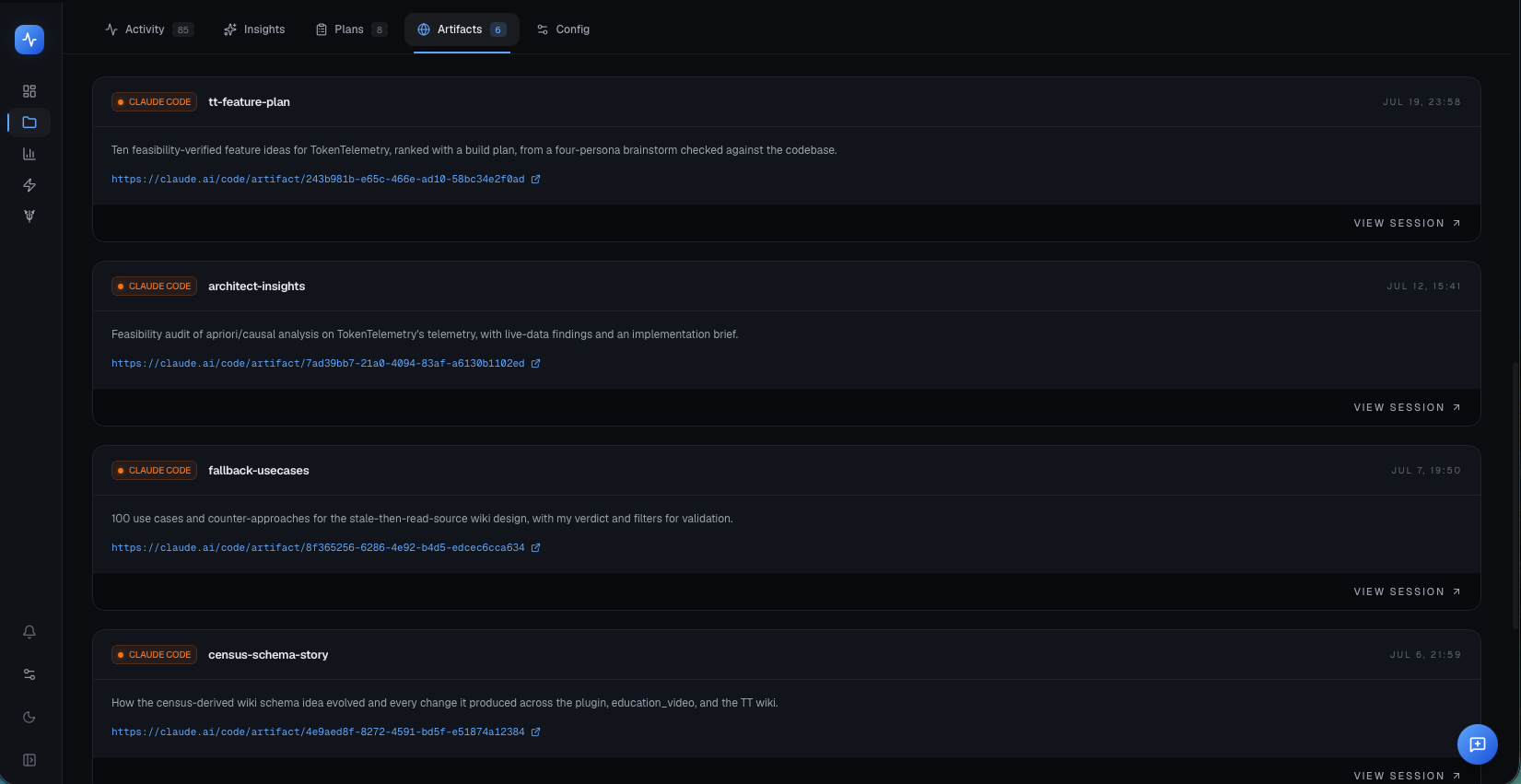
Details worth knowing:
- Redeploys keep their URL. Republishing the same page updates the existing entry rather than adding a duplicate; the latest publish wins, and metadata a redeploy omitted is kept from the earlier one.
- Worktree publishes roll up. Pages published from a git worktree session appear on the main repository's project card, since that's where the work belongs.
- Links outlive transcripts. Published URLs are kept in the durable history store, so deleting old Claude transcripts doesn't lose the links — the pages themselves are hosted.
- Only real publishes are listed. Listing calls and failed publishes are ignored.
Antigravity documents
Google Antigravity writes first-class artifacts per session into its brain store: task.md, implementation_plan.md, and walkthrough.md, each with a metadata sidecar carrying a summary and updated time. TokenTelemetry surfaces the user-facing ones with:
- a title taken from the document's first heading,
- the summary Antigravity wrote for it,
- a link to the raw document and to the session that produced it.
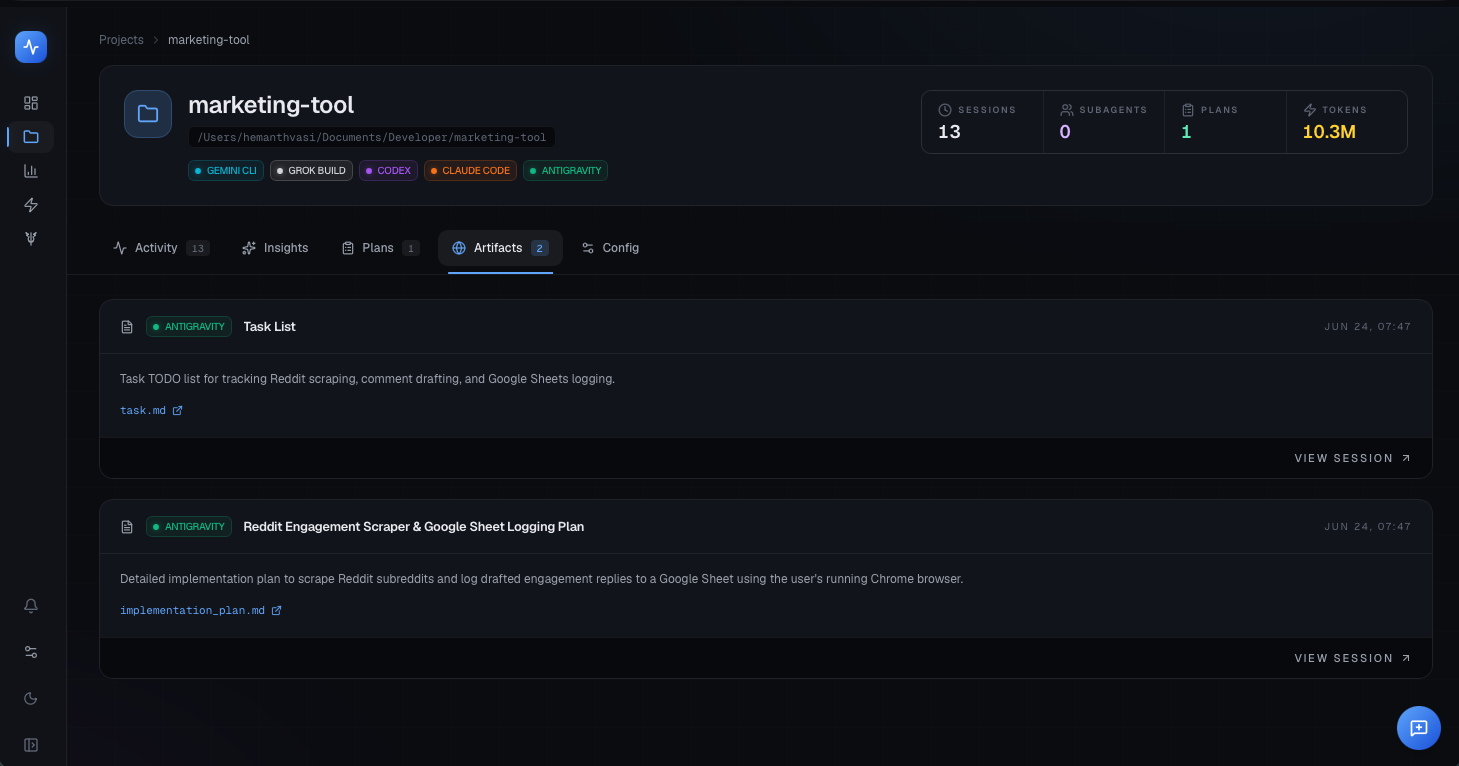
Documents Antigravity marks as not user-facing (internal notes) are excluded from the project tab, though they remain visible among the session's raw files.
Viewing options
The project Artifacts tab has a Cards / List toggle. The choice is persisted per browser.
- Card view shows an inline preview for each artifact. Claude published pages render a scaled-down preview of the local HTML source, only while that source file still exists on disk; the hosted page itself is never fetched. Antigravity documents get an expandable markdown preview.
- List view is a compact table, one row per artifact, for scanning many at once.
The session Artifacts tab
Inside a session trace, the Artifacts tab shows everything the session produced:
- Published pages — Claude Code's hosted pages, linked externally.
- Screenshots and images — captured by browser automation, viewable inline with zoom.
- Browser recordings — for Antigravity, sampled thumbnail strips from its
browser_recordingsstore let you scrub a visual replay of what the agent browsed. - Documents —
task.md, plans, walkthroughs, audit reports, and similar files, downloadable or viewable in the browser. - Videos —
.mp4/.mov/.webmfiles, played inline.
Per-agent support
Published pages come from Claude Code. Document, screenshot, and recording artifacts come from Antigravity's brain store. Other agents' sessions show whatever files their storage exposes — for example Claude project memory files — and gain artifact types as their agents start producing them.
How files are located
Local artifact files are served by the backend's /artifacts endpoint from their original location on disk — TokenTelemetry never copies them. If an agent deletes its session data, its file artifacts disappear with it; Claude published pages keep working because only the URL is stored.